Chargement...
17 May 2026
3 min read
The Party Wall in Brussels: Guide to Vertical Extension, Purchase, and Shared Ownership
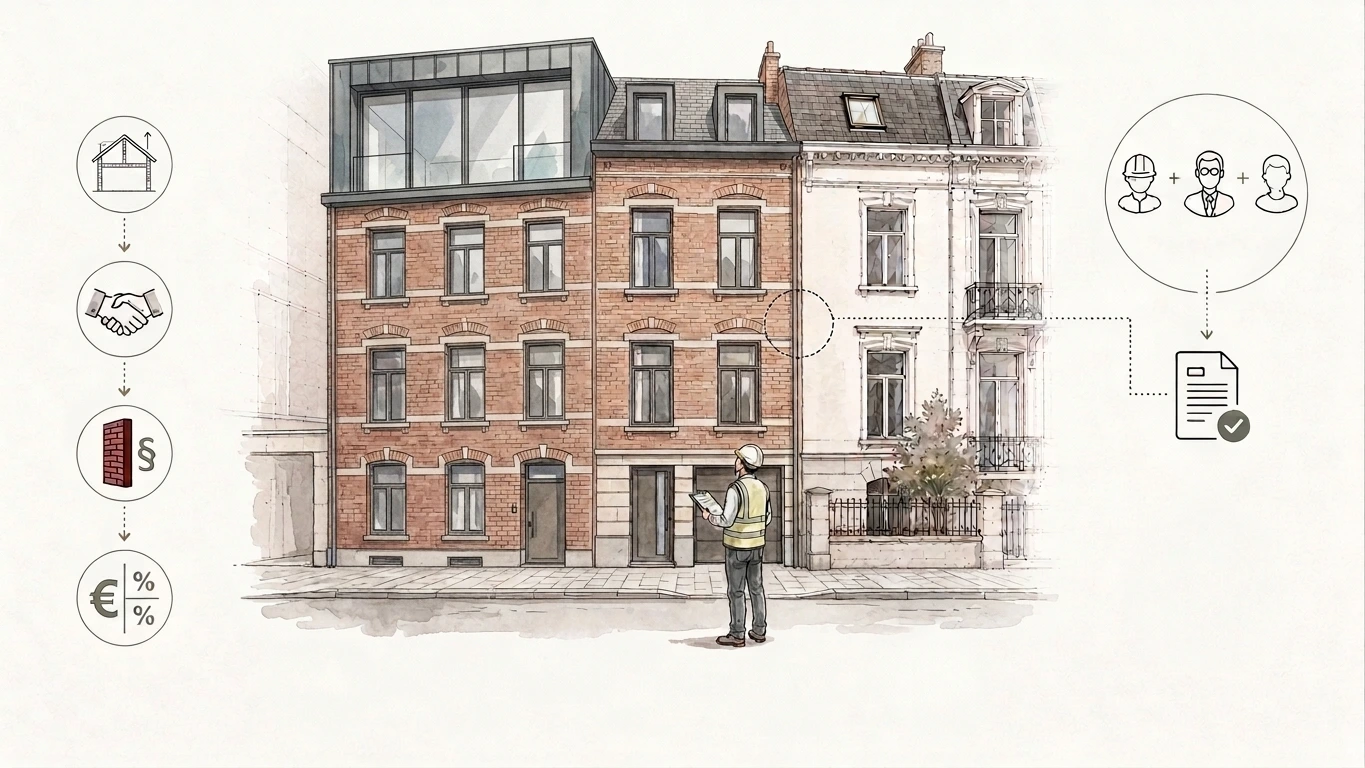
In Brussels, where continuous terraced housing defines the urban landscape, boundary partition walls are central to almost every renovation and vertical extension. Party wall co-ownership (mandeligheid) is a complex legal domain, extensively reformed under Book 3 of the Belgian Civil Code in 2021. Who owns the wall? How do you legally execute a vertical extension? And how is party wall compensation calculated? Here is the complete technical and legal framework.
1. Shared Party Wall or Private Masonry? Legal Presumptions
A party wall is a boundary partition wall constructed across the property line of two adjoining parcels, held in forced statutory co-ownership (mandeligheid / mitoyenneté). Under the Belgian Civil Code, any wall separating two contiguous buildings is legally presumed to be a shared party wall up to the height of the lower building.
The section of the wall extending above the lower building's roof is legally presumed private property belonging solely to the taller building's owner. This presumption may be rebutted by notarial title deeds or physical non-shared architectural evidence (such as asymmetrical coping stones shedding rainwater exclusively to one side).
2. Vertically Extending a Party Wall: Builder Rights and Obligations
If you are undertaking a vertical rooftop extension or building a rear annex taller than your neighbor's property, Belgian law grants a fundamental right: any owner may raise the party wall at their sole exclusive expense.
This statutory right entails strict technical and legal duties:
Structural Stability and Thickness: The vertical extension must be built on your half of the wall thickness, or across the full width if structural stability permits. If the existing party wall cannot support the loads of the new story, the builder must reinforce or reconstruct the entire wall at their own cost and indemnify the neighbor for temporary disruption.
Weatherproofing and Exterior Finishing: When raising a wall requires modifying the neighbor's roof connections (zinc flashings, counter-flashings), the builder must restore conditions to perfection and bear full responsibility for weatherproofing the newly exposed exterior masonry (cladding, slates, or rendering).
3. Party Wall Buyouts: When and How Much to Pay
The reformed Civil Code (Book 3) clarifies mandatory party wall acquisition rules:
When is a buyout mandatory? As soon as an owner utilizes the neighbor's private wall section for structural support, beam anchoring, or building enclosure, they are legally required to purchase shared co-ownership of the utilized area.
Compensation Formula: The buyout price equals 50% of the current replacement cost of the wall (labor and materials at current market rates), minus depreciation for age and wear, plus 50% of the underlying land value supporting that portion of the wall.
This technical valuation must be formalized in an official surveyor survey report (procès-verbal de mitoyenneté) prepared by a chartered surveyor or architect, and registered with the Legal Security Office (registration office).
Advice :Never begin structural interventions adjoining boundary walls without an adversarial pre-works condition survey. Secure written agreements on party wall acquisitions and valuations prior to breaking ground to eliminate the risk of emergency court injunctions halting your construction site.
Planning an extension or vertical rooftop project in Brussels and need expert party wall valuation or negotiation assistance?
Need Technical Advice?
Our architectural engineers analyze your project and provide tailored technical solutions.