Chargement...
27 Mar 2026
3 min read
Understanding the Brussels PEB Energy Certificate: Far More than a Simple Rating
The PEB certificate has become the true energy identity card of your property. Far from being a mere administrative constraint during a sale or lease, this document provides vital insights to understand and enhance the value of your real estate. But how is it actually calculated? And why does it often differ from your actual energy bills? A comprehensive guide to the Energy Performance of Buildings certificate.
An Objective Comparison Tool
Some occupants heat their homes to 22°C all day long, while others maintain 19°C only in the evening. How can one objectively compare the energy performance of two different properties? To eliminate occupant bias, the PEB energy certificate relies on a standardized consumption model rather than actual utility bills.
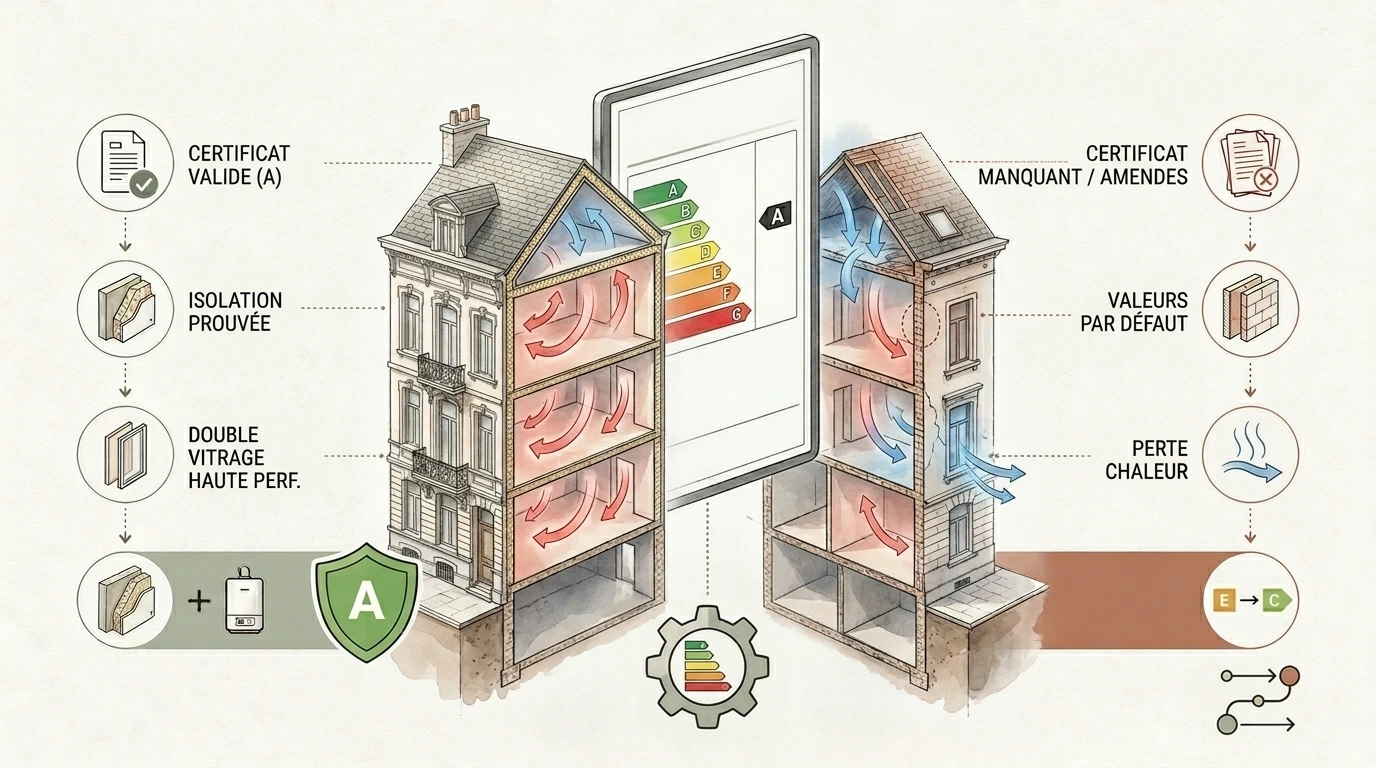
It calculates theoretical building energy consumption under identical parameters for all properties (standard weather conditions, steady indoor temperatures) based on building envelope characteristics (roof and wall insulation, glazing specifications) and technical systems (heating, domestic hot water). The result is expressed in primary energy consumption (kWh/m²/year) and ranked on a scale from A (highly efficient) to G (energy intensive).
A Strict Legal Obligation
In the Brussels-Capital Region, holding a valid PEB certificate is mandatory prior to listing any residential property of 18 m² or more for sale or rent. Property owners must display the energy class rating across all advertising and real estate portals.
The certificate remains valid for 10 years. However, having it updated earlier is strongly recommended if you have added insulation or upgraded your heating system, ensuring that your improved energy rating is officially recognized and enhances market value. Significant administrative fines apply in the absence of a valid certificate.
The Common Misunderstanding: PEB vs Real Energy Bills
Many homeowners are surprised by the discrepancy between their moderate annual heating bill and a lower-than-expected PEB score. This difference is explained by two structural factors:
Primary Energy: PEB does not measure "final energy" (metered at your consumption point), but "primary energy", factoring in the energy required to generate and transmit electricity or gas to your home.
Lack of Acceptable Evidence: PEB audits are strictly regulated. If an assessor cannot visually verify concealed wall insulation and you cannot provide detailed invoices, regulations mandate applying "default penalty values". The software calculates the wall as uninsulated, significantly lowering the overall rating.
The Renovation Pathway: Your Roadmap
Beyond scoring, the PEB certificate functions as a strategic planning roadmap. The Brussels Government has set mandatory targets: by 2033, all residential units must consume no more than 275 kWh/m²/year (Class E), lowering to 150 kWh/m²/year (Class C) by 2045.
To guide you, your PEB certificate includes a customized renovation scenario detailing prioritized measures (such as roof insulation or high-efficiency window replacements) alongside projected energy reductions and improved ratings.
Advice :Do not just look at the final energy rating letter. Examine the "Encoded Data" section in your report to identify where default penalty values were applied (indicated with red exclamation marks). If you locate detailed invoices or progress photos documenting that insulation, you can request an updated audit to instantly boost your official score.
Need a new PEB certificate or an expert review of your technical documents before listing your property? Consult the certified PEB assessors at Sahm & Partners.
Useful external link: Check if a property already has a valid certificate on the Official Brussels PEB/EPB Register ↗.
Need Technical Advice?
Our architectural engineers analyze your project and provide tailored technical solutions.