Chargement...
4 May 2026
2 min read
How to Prepare for Your PEB Assessor Visit in Brussels to Avoid Poor Ratings
Are you selling or renting a residential property in Brussels? The certified PEB assessor audit directly impacts your property market value. Yet, many poor energy ratings do not stem from poor insulation, but simply from missing documentary evidence during the inspection. Here is the exact methodology to prepare your records and fully capture every euro invested in renovations.
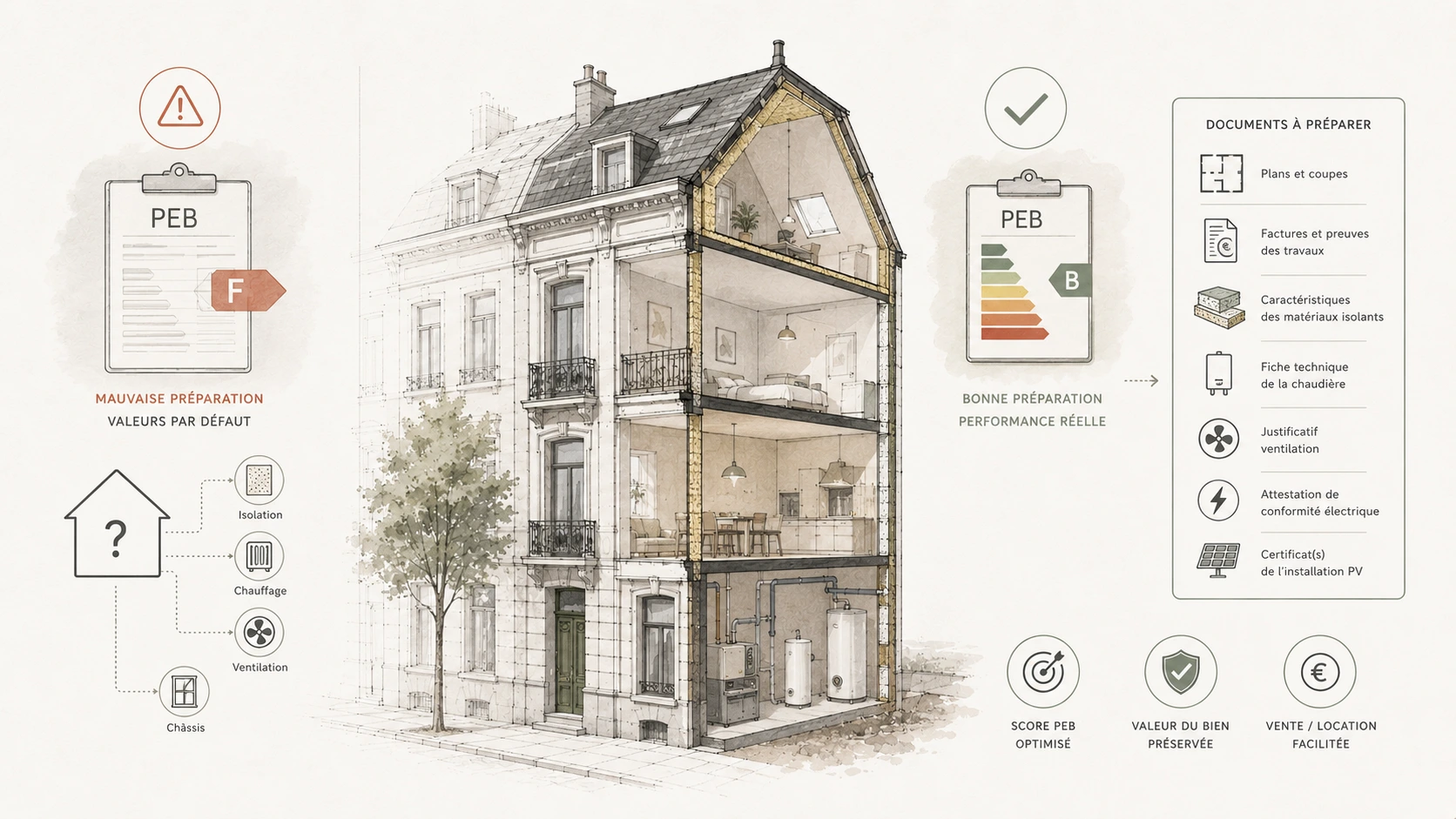
The Costly Penalty of Default Software Values
Certified PEB assessors operate under strict regulatory protocols established by Brussels Environment (Leefmilieu Brussel). Assessors are legally prohibited from guessing insulation thicknesses behind finished drywall or adjusting ratings based on verbal claims.
If an auditor cannot visually inspect an insulation layer and you cannot produce compliant documentation, the regional calculation engine automatically applies "default penalty values". The system assumes the worst-case scenario: cavity walls are calculated as uninsulated, and renovated roofs receive the baseline thermal performance of uninsulated original construction. As a result, a property with actual C or D performance can fall to an F or G rating, triggering immediate market depreciation.
Acceptable Evidence: Exactly What to Prepare
To maximize your energy rating and prove the presence of high-efficiency materials, prepare a comprehensive evidentiary file containing acceptable proofs under Brussels regulations:
Detailed Contractor Invoices: An invoice stating merely "Insulation work" is legally insufficient. It must explicitly specify the brand, product type, lambda thermal conductivity, and exact installed thickness.
Architect Plans and Specifications: Detailed architectural execution drawings and specifications substantiate the layered composition of walls and roofs.
Technical Data Sheets and Packaging Labels: Technical documentation or packaging labels (e.g., rigid insulation boards under basement ceilings) are valid when the assessor can visually match them to the on-site installation.
Beyond the Letter Grade: A Customized Renovation Pathway
Beyond assigning a rating grade from A to G, the PEB certificate serves as a strategic roadmap for property improvements through a tailored renovation scenario.
It outlines prioritized energy efficiency upgrades necessary to achieve Brussels regional milestones (requiring maximum consumption of 275 kWh/m²/year or Class E by 2033). The report calculates current heat transfer coefficients, target post-renovation values, and projected energy cost savings.
Advice :Systematically photograph energy efficiency upgrades during construction before finishes conceal the insulation. For photographs to be recognized by PEB assessors, always include a clearly legible measuring tape in the frame to irrefutably document the exact insulation thickness.
Need a pre-audit document review or a certified PEB inspection in Brussels? Contact the engineering team at Sahm & Partners.
Useful external link: Verify certificate status on the Official Brussels PEB Register ↗.
Need Technical Advice?
Our architectural engineers analyze your project and provide tailored technical solutions.